


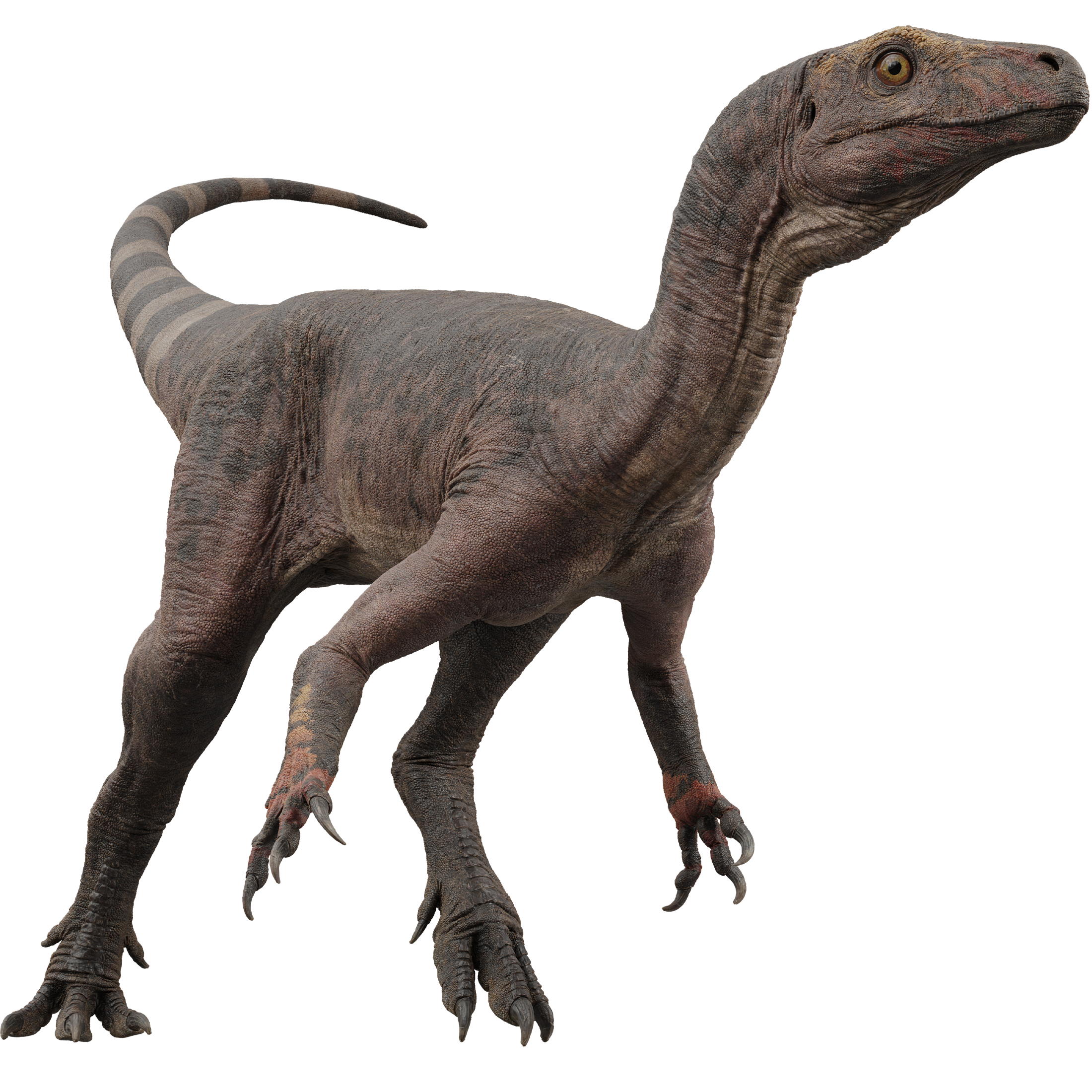

The Dawn Dinosaur
This diminutive dinosaur, once thought to be an early theropod, has since been reinterpreted as a basal sauropodomorph, but Eoraptor is nevertheless thought to be very similar to how the first dinosaurs would have looked, and offers vital clues to our understanding of the origin or dinosaurs.
Overview: 131 million years ago in what would become Argentina lived a small predator called Eoraptor, discovered in the late 20th century by Ricardo Martínez and named by Paul Sereno. It was once thought to be the earliest known theropod, if not something close to the ancestor of all dinosaurs. It has since been reinterpreted as a basal sauropodomorph, but Eoraptor is nevertheless thought to be very similar to how the first dinosaurs would have looked and offers vital clues to our understanding of the origin or dinosaurs. At scarcely a meter long, and with an omnivorous diet of small vertebrates, insects, and plants, it is amazing to think that little creatures like these would be the forebearers of both the largest and most ferocious animals ever to walk the earth.
Discovery: Eoraptor lunensis was discovered in 1991 in the Valley of the Moon of San Juan, Argentina, by Ricardo Martinez during a joint dig with the Field Museum of Natural History (Chicago, USA) and the University of San Juan (Argentina). The bones were sent to Chicago for preparation and description, and the animal was named in 1993 by Paul Sereno, Catherine Forster, Raymond R. Rogers, and Alfredo M. Monetta. Eoraptor means “Dawn Thief”, from the Greek word “eós”, meaning “dawn” and the Latin word “raptor”, meaning “thief/plunderer”. The name was chosen because it was a very primitive dinosaur which lived at the dawn of their reign. “Raptor” was chosen due to Eoraptor’s presumed carnivorous diet and its grasping hands. The species name lunensis means “from the moon”, referring to The Valley of the Moon, or Valle de la Luna in Spanish, where it was found. The holotype (PVSJ 512) is mostly complete, including the skull and most of the skeleton with the exception of part of the tail.
Evolution: Eoraptor was chronologically one of the earliest known dinosaurs, dating to between 231 and 228 million years ago. It was also at one time thought to be possibly the first dinosaur, or very much like the first dinosaur, whatever that was. Over the years it has been classified as a basal theropod, a basal saurischian (“lizard-hipped” dinosaurs; the clade that includes both theropods and sauropodomorphs), and most recently, a basal sauropodomorph. Currently it is generally recognized as the latter, but its classification could change again as more research is done. In any case, Eoraptor is still thought to be very similar in appearance to the hypothetical ancestor of all dinosaurs. Until such a dinosaur is discovered, Eoraptor will likely continue to be the basis of our understanding of how the first dinosaurs looked and behaved.
Physical Description: Eoraptor had a basic theropod-like dinosaur body plan, with a relatively long s-curve neck, a long tail, and a bipedal stance and digitigrade (walked on its toes) feet. It was small, only 1–1.3 meters (3.25–4.27 ft) in length, weighing around 10 kilograms (22 lbs), and standing less than two feet tall. It had long legs that would have granted it both speed and agility, hands well adapted for grasping, and large eyes that would have given it excellent vision. The hands had five fingers, but only the middle three had claws, and the other two were reduced. Theropods would later lose these extra two fingers. The teeth of Eoraptor were leaf-shaped in the front and blade-like in the back, indicating an omnivorous diet, though it may have been more primarily carnivorous. Eoraptor was probably warm-blooded and might have had a coat of downy feathers, which may have been a trait shared by the common ancestor of all dinosaurs.
Ecology: Eoraptor was found in the Ischigualasto Formation which represents a rich floodplain environment with abundant plants, including ferns, horsetails, and cycads, and towering above them, relatives of ginkgoes, monkey puzzles, and redwoods. The climate was lush enough to support these plants, but rain was highly seasonal, and there was probably a distinct wet and dry season. Large herbivores included the dicynodonts Ischigualastia and Jachaleria, the herbivorous cyndont Exaeretodon, and the aetosaur (an armored herbivorous relative of crocodiles) Aetosauroides. Small herbivores would have included rhynchosaurs and the enigmatic dinosaur-like silesaurids. Small predators included cynodonts, the early crocodylomorph, Trialestes, and the early theropod Eodromeus. Larger predators included the large theropod Herrerasaurus, and the giant Saurosuchus, a “rausuchian” terrestrial relative of crocodiles. Eoraptor occupied a role as omnivore, though likely leaned more toward being a carnivore, and was probably a frequent predator of insects and small vertebrates like juvenile rhynchosaurs, early relatives of lizards, and probably scavenging carrion left by larger predators. It shared its omnivorous niche with the slightly larger and slightly more derived sauropodomorph Panphagia. Eoraptor’s small size meant that it would have had to keep a sharp eye out for larger predators, including Herrerasaurus and Saurosuchus. Near waterways, Eoraptor also would have had to be wary of semiaquatic predators like the large temnospondyl amphibians Promastodonsaurus and Pelorocephalus and the crocodile-like proterochampsid reptile Proterochampsa.
Extinction and Legacy: Eoraptor was essentially the protypical dinosaur, but as dinosaurs diversified and spread, primitive forms like Eoraptor were soon replaced by more specialized forms. Theropods became the world’s dominant terrestrial predators, and they got good at it, while sauropodomorphs moved toward an herbivorous diet and became the dominant herbivores for most of the Mesozoic. Eoraptor and creatures like it were the starting point for all dinosaurs, but they quickly, in just a few million years, moved beyond them, and thus Eoraptor became one of the first dinosaurs to go extinct. But its descendants would go on to rule the world for another 172 million years, and even after their reign ended, some few survived and now surround us as some 10,000 species of extant birds. The holotype of Eoraptor is housed in the Museum of Natural Sciences in San Juan, Argentina. Skeletal displays of Eoraptor can be seen in various museums, including The Museum of Ancient Life at Thanksgiving Point in Lehi, UT, USA, and the Royal Ontario Museum in Toronto, Ontario, Canada.
Eoraptor FAQ
Eoraptor size / How big was Eoraptor?
See height, weight, and length.
Eoraptor height / How tall was Eoraptor?
Eoraptor was around 0.48 meters (1.58 ft) tall.
Eoraptor weight / How much did Eoraptor weigh?
Eoraptor probably weighed around 10 kilograms (22 lbs).
How long was Eoraptor?
Eoraptor grew 1–1.3 meters (3.25–4.27 ft) in length.
What did Eoraptor eat?
Eoraptor was probably not a picky eater, occupying an omnivore niche, though its preferred food was probably insects, small vertebrates, and carrion.
What is Eoraptor closest living relative?
Like all dinosaurs, the closest relatives of Eoraptor are the only surviving lineage of dinosaurs today, the birds. Crocodilians, while not dinosaurs themselves, are also more distant cousins of dinosaurs.
Eoraptor family members / Eoraptor family / What kind of dinosaur was Eoraptor?
Despite resembling a theropod, and indeed likely resembling the very first of all dinosaurs, Eoraptor was one of the earliest sauropodomorphs (sauropods and their earlier relatives).
Where did Eoraptor live? / Where was Eoraptor found?
Eoraptor lived in what is now Argentina!
When did Eoraptor live?
Eoraptor lived about 231-228 million years ago during the Late Triassic Period.
What does Eoraptor mean? / Eoraptor name meaning
Eoraptor means “dawn thief”.